
Website
28 September 2026 · 5 min read
Why Your Website Isn't a Project, It's a Product
Lisa
Digital Marketing Specialist at Stackdbase
Most people treat their website like a project. You build it, you launch it, you move on. But a website is a product. Here's how to shift your mindset.
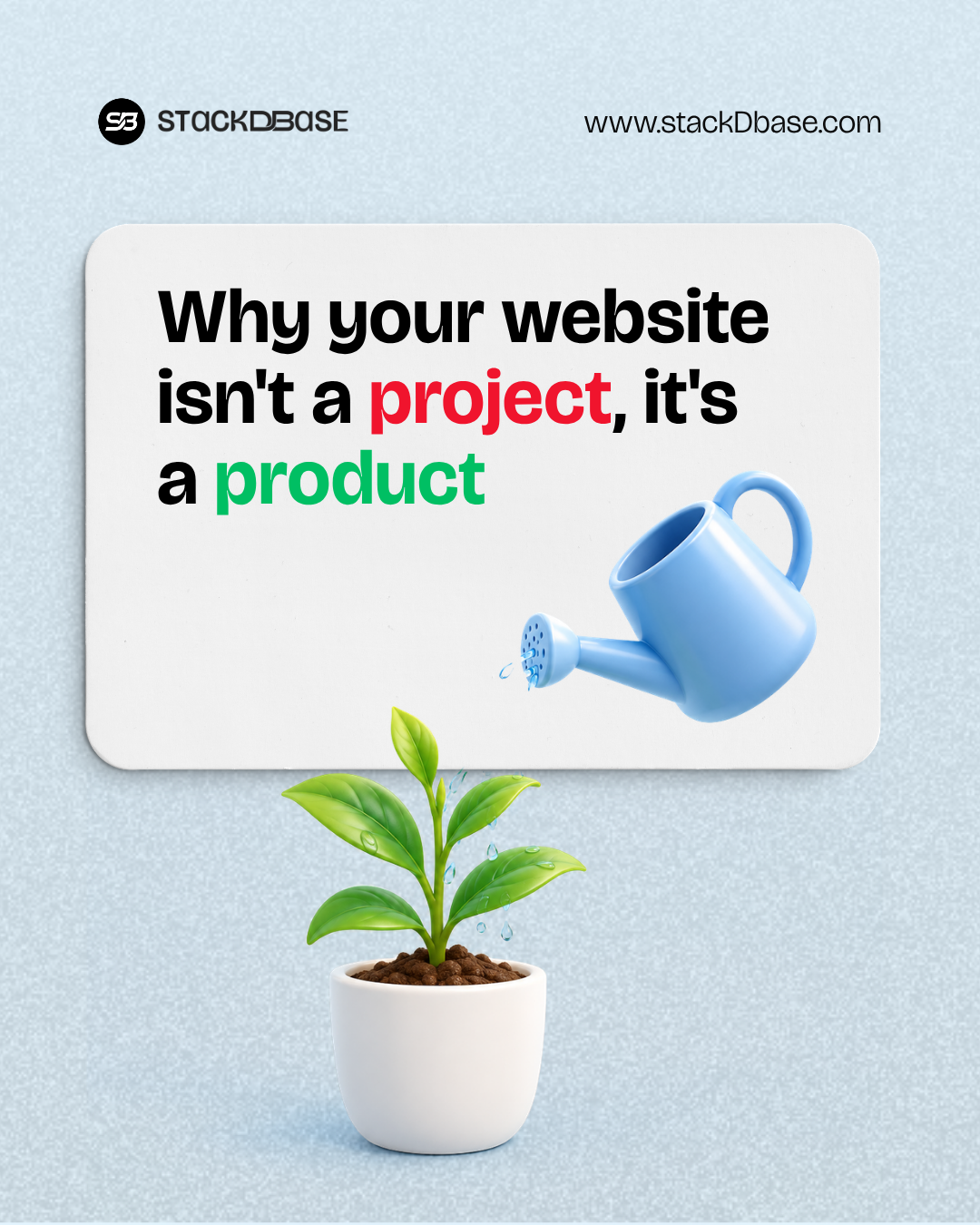
Most people treat their website like a project. You build it, you launch it, you move on. You might revisit it in a year or two. Maybe. If something breaks, or someone complains. But a website is a product. It needs maintenance, iteration, care. The best sites are never finished, they're just live.
The Project vs. Product Mindset
Project Mindset
Launch is the finish line We'll fix it later It's done Set and forget Reactive.
Product Mindset
Launch is the starting line We'll improve it continuously It's working. Let's make it work better Test and learn Proactive
Why This Matters
1. Your Customers Change
What worked last year might not work this year. New expectations, new devices, new behaviours.
2. Your Competitors Change
If they're improving and you're not, you're falling behind.
3. Technology Changes
Browsers update, platforms evolve, what was fast becomes slow.
4. Your Business Changes
New products, new services, new goals. Your website should reflect that.
The Framework: From Launch and Leave to Continuous Improvement
Step 1: Launch
Get it live. Don't wait for perfect, perfect never comes.
Step 2: Watch
The first week is critical. Watch how people use it. Where they click, where they drop off.
Step 3: Learn
The first month tells you what's working. What's confusing, what needs fixing.
Step 4: Improve
Make small changes. Test them, keep what works, discard what doesn't.
Step 5: Repeat
This isn't a one-time thing, it's a habit, a rhythm.
What to Track
Metric
Bounce rate Time on page Conversion rate Page speed Mobile behaviour Search rankings
What It Tells You
Are people leaving immediately? Are they engaged? Are they taking action? Is the site fast enough? How do mobile users behave? Are you visible?
What to Improve First
1. Speed
If your site is slow, nothing else matters. Fix speed first.
2. Clarity
Can visitors understand what you do in 5 seconds? If not, fix the messaging.
3. Calls to Action
Are they obvious? Are they compelling? Are they easy to find?
4. Trust Signals
Testimonials. Case studies. Reviews. Proof that you deliver.
5. Mobile Experience
Most traffic is mobile, test on mobile first.
How to Build a Product Mindset
1. Schedule Regular Reviews
Monthly, quarterly. Put it in the calendar.
2. Assign Ownership
Someone needs to be responsible. Not everyone, someone.
3. Set Goals
What does success look like? More leads? More sales? More engagement?
4. Test One Thing at a Time
Change one thing. Measure, learn, repeat.
5. Celebrate Improvements
Small wins matter. A faster page, a clearer headline, a better button.
Your website isn't a project, you don't build it once and move on, it's a product. It needs maintenance, iteration and care. The best sites are never finished, they're just live. Ready to treat your website like a product? Let's talk.
Download file ↓More reading
Other notes from the studio.
Marketing
Why Asking for a Review Is the Most Underrated Marketing Tactic
A good review is worth 10 paid ads. It's social proof that works while you sleep. Yet most brands don't ask. Here's how to start.
Audience
How to Build Trust with a Skeptical Audience
Skeptical customers don't buy because of your design. They buy because of your credibility. Here's how to build trust that converts.