
Branding
16 September 2026 · 5 min read
The Hidden Cost of Saying "Yes" to Every Client Request
Lisa
Digital Marketing Specialist at Stackdbase
Every yes has a cost: Time, focus, it might even cost your edge. Here's how to say no without losing the client.
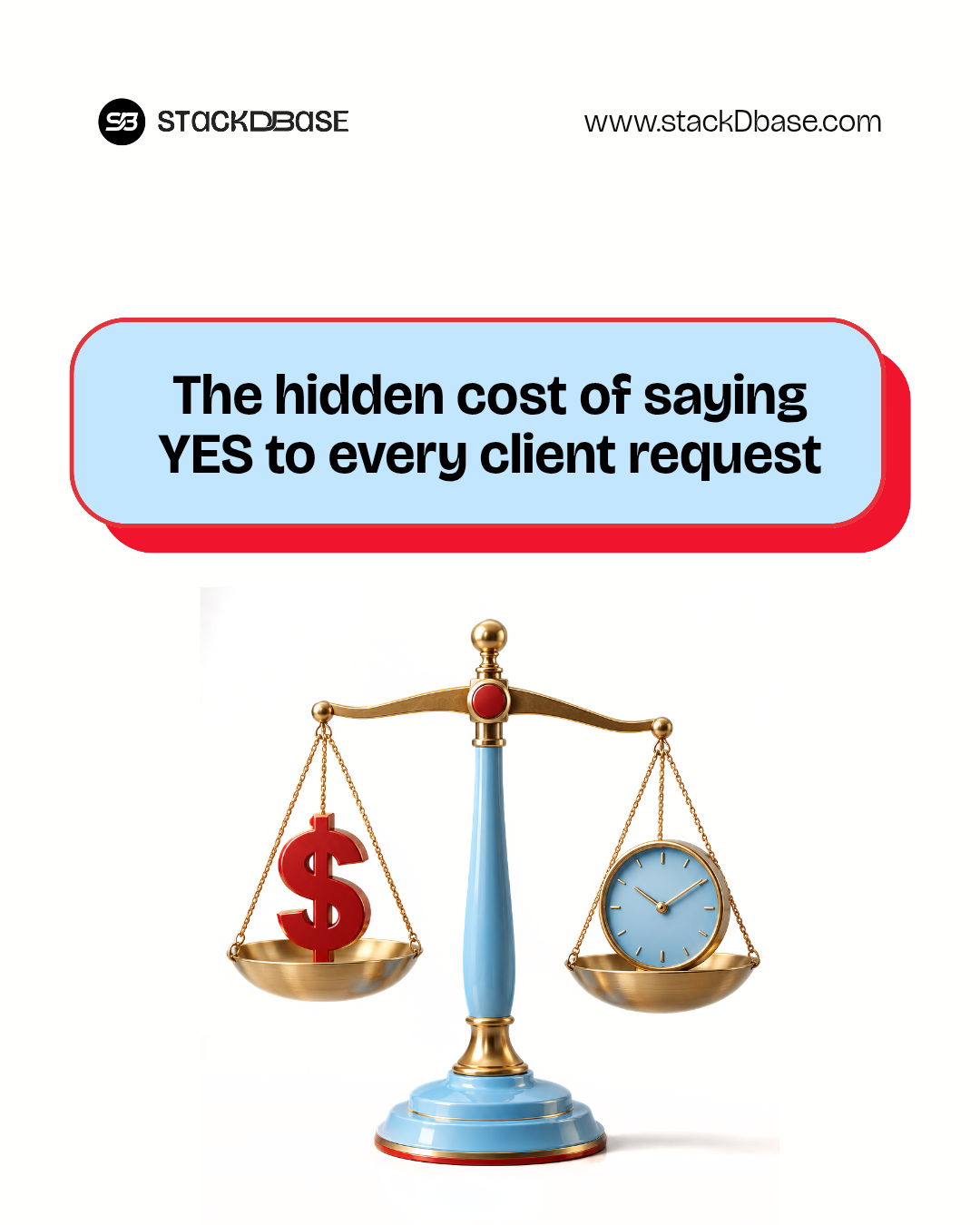
Every "yes" has a cost. It costs time, it costs focus, it costs the energy you could have spent on your best clients. And yet, most of us say yes to almost everything.
A client asks for a small favour. Yes. A prospect wants a discount. Yes. A project scope creeps. Yes. A deadline gets moved. Yes. We say yes because we want to be helpful, because we're afraid of losing the work, because saying no feels risky. But the hidden cost of pleasing everyone is losing your edge.
Why We Say Yes to Everything
1. Fear of Missing Out
What if this is the big break? What if they tell others? What if saying no means losing the client forever?
2. The Desire to Please
We want to be liked, we want to be helpful, we want to be the person who says yes.
3. The Slippery Slope
It starts small. A tiny favour, a little discount, a small scope addition. And then it becomes the norm.
4. The Sunk Cost Fallacy
We've already invested time, we've built the relationship. Saying no now feels like wasting what we've already put in.
The Hidden Costs
1. Time
Every yes takes time. Time you could spend on your best clients, time you could spend on business development, time you could spend on yourself.
2. Focus
Every yes fragments your attention. You're juggling more projects, you're context-switching constantly, you're never fully present on any one thing.
3. Energy
Yes every time drains energy. The energy you need to do great work, the energy you need to be creative, the energy you need to show up fully.
4. Quality
Every yes dilutes quality. You rush, you cut corners, you deliver work you're not proud of, and your reputation suffers.
5. Your Edge
Every yes makes you more of a generalist, less of a specialist. You become the person who does everything; not the person who does one thing exceptionally well.
The Cost of Saying Yes to the Wrong Clients
They drain your resources.
The wrong clients take up the most time. They're the most demanding. They're the least appreciative. They're the ones who never refer you.
They set a precedent.
When you say yes to the wrong client, you're teaching them that everything is negotiable, boundaries are flexible, your process is optional.
They attract more wrong clients.
The wrong clients refer other wrong clients. Before you know it, your entire roster is people who drain you.
They push out the right clients.
Every yes to the wrong client is a no to a better opportunity. You can only do so much. Who are you doing it for?
How to Say No Without Losing the Client
1. Be Clear About Your Process
Set expectations upfront. "Our process includes X, Y, and Z. Anything outside of that is a separate conversation."
2. Offer a Trade-Off
Instead of a flat no, offer a trade-off. "We can add that feature, but it will push the timeline by two weeks. Is that okay?"
3. Be Honest About Capacity
"I'd love to help, but we're at capacity right now. I don't want to overpromise and underdeliver."
4. Recommend an Alternative
"I'm not the right fit for that, but I know someone who is."
5. Practice the Pause
Don't answer immediately. Say, "Let me think about that and get back to you." It gives you time to consider the real cost.
Instead of saying yes to everything:
✅ Say yes to the right things. ✅ Say no to the wrong things. ✅ Protect your time, energy, and focus. ✅ Do great work for the right people. ✅ Build a business you're proud of.
A Simple Test
Before you say yes, ask yourself: "If I say yes to this, what am I saying no to?" If the answer is "something more important," then the answer is no.
"Every "yes" has a cost."
It costs time, it costs focus, it costs the energy you could have spent on your best clients. The hidden cost of pleasing everyone is losing your edge. At StackDbase, we've learned to be selective. Not because we're arrogant, because we want to do great work for the right people. Ready to work with a team that says no to the wrong things? Let's talk.
More reading
Other notes from the studio.
Marketing
Why Your "Boring" Industry Is Your Biggest Marketing Advantage
If you're in a "boring" industry, you have an advantage. Your competitors are probably doing boring marketing. Here's how to stand out.
Branding
The "About Us" Page Is Not About You Excerpt:
Your About Us page shouldn't be a biography, it should be a promise to your customer. Here's how to build trust at scale.